
Paid ads are the fastest way to put your business in front of people who did not know you existed yesterday. But "running ads" is not one thing. The ads that work depend on whether your customer is already looking for you or not.
Two kinds of buyers, two kinds of ads
There are people searching for what you do right now. They type "emergency plumber near me" or "brake repair open Saturday" and they want an answer in minutes. Google ads put you at the top of that search, and you pay for the click.
Then there are people who have not started searching yet. They are scrolling Facebook or Instagram after dinner. They did not wake up thinking about a new roof, but a clear offer with a photo of a job you finished can stop them mid-scroll. That is where Facebook and Instagram ads do their work.
Neither channel is automatically better. Search ads catch demand that already exists. Social ads create it.
Targeting is what makes it local
The main advantage of paid social for a service business is the targeting. You choose the towns, the radius, and sometimes the interests that match your customers, so your ad only shows inside that bubble. A roofer in one county should not be paying to show a roof offer three states away.
Search ads handle location differently. You choose where the ad can appear, and the searcher's own words do the qualifying. Someone searching for your exact service in your town is telling you what they want and where they are.
What happens after the click
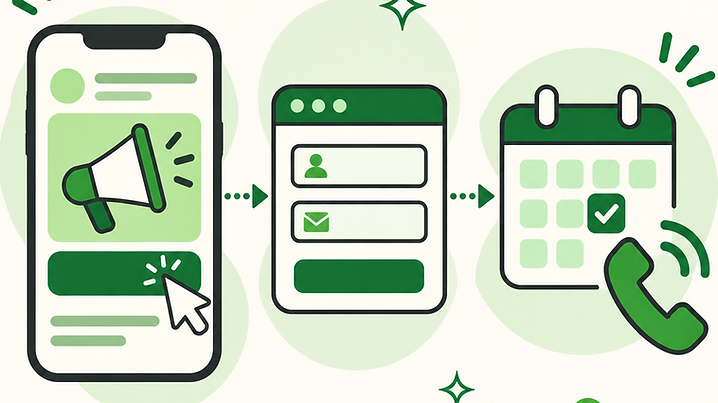
The ad only buys attention. What happens in the next ten seconds decides whether you get a lead.
A visitor lands on your page and needs three things immediately: what you do, where you do it, and an easy way to reach you. A phone number they can tap, a short form, or a booking link that actually works on a phone. If someone has to hunt for the contact details, they leave and the click was wasted.
This is where most local campaigns quietly fail. The ads get clicks, the landing page does not turn them into inquiries, and the budget disappears with nothing to show for it.
Where the budget usually leaks
- One catch-all ad pointing at the home page, no matter what the person searched for
- A landing page that loads slowly on a phone
- No follow-up for the people who filled out a form and then went quiet
- Turning the campaign off after a week because the phone had not rung yet
- Judging results by clicks instead of booked appointments
How to tell it is working
Watch inquiries, not impressions. If people are calling and submitting forms, the ads are doing their job. If they are clicking and leaving, the problem is usually the page or the offer, not the ad platform.
Give a campaign enough time to gather real data before you change it. Then fix one thing at a time, usually the offer or the landing page first, so you can tell what made the difference.
The short version
Paid ads deliver a steady flow of people who are already interested in what you sell. They do not replace a working page, fast answers, or follow-up. Put those in place and the same budget produces far more booked work.